



House from Nieder-Gemünden
Built: circa 1677
Dismantled: 1979
Reassembled: 1979 bis 1981
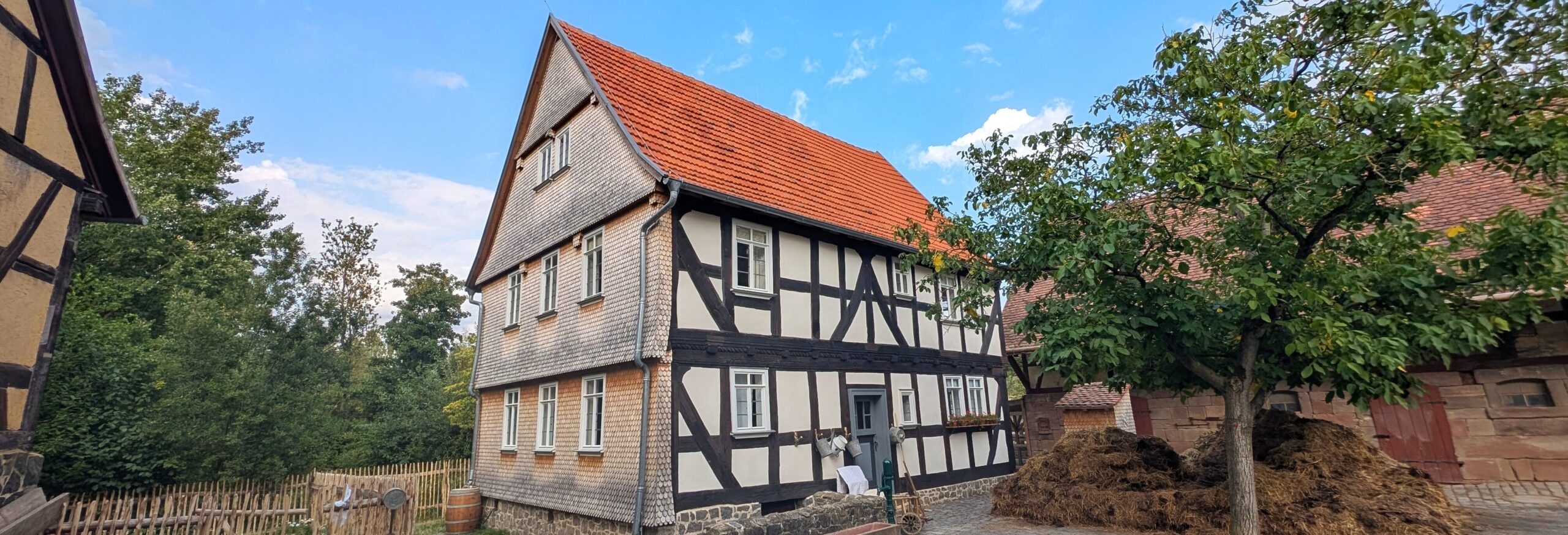
The two-storey residential house from Nieder-Gemünden was originally part of a three-sided farmstead. In the 1960s it increasingly became a traffic obstacle, and after a tank accident involving a neighboring building the pressure to widen the road grew. In 1979 the decision was made to dismantle the house. Between 1979 and 1982 it was reconstructed at the open-air museum. From 2021 to 2025 the building underwent extensive restoration. Today the ensemble is presented in the time frame around 1910 – complete with a large manure heap in the courtyard.
The “Feldmann-Becker House” was built after 1677 and served as the residence of its owning families for fifteen generations. The associated “Traiser Estate” had already been mentioned as early as 1582. Originally named after the Dreyß (later Threiß) family, it came into the possession of the Feldmann family around 1755 through marriage. The family history of the 19th century is particularly striking: Wilhelm Feldmann (1818–1885) was placed under guardianship in 1876/77 due to a wasteful lifestyle, while his son Carl Ludwig Feldmann (1852–1909), a local poet and singer, remained unmarried. The estate then passed to Carl’s sister Marie and her husband Karl Friedrich Fisseler. Their sons served in the Leibgendarmerie of Kaiser Wilhelm II; August volunteered in the suppression of the Boxer Rebellion in China and died of typhus in Egypt on his return journey in 1901. In 1909, Marie’s daughter Lina and her husband Karl Becker took over the farm – giving the house its present name, the “Feldmann-Becker House.”
Around 1930, entry to the house was through the ground-level Ern into the kitchen. To the right lay the parlor with its adjoining bedchamber, to the left the side room. Under the staircase was the potato and beet cellar, while the main cellar was accessible only from the outside. Upstairs were the living room, bedroom, servant’s chamber, and several storage rooms.
Today, the building complex with its large manure heap in the courtyard is shown as it would have looked around 1910. This was a period of social and agricultural modernization that profoundly changed everyday life in rural Hesse. Under the theme “Farm Life 1910,” the museum theater brings the house and yard to life, offering visitors insight into a time marked by great transformation.
You are currently viewing a placeholder content from Google Maps. To access the actual content, click the button below. Please note that doing so will share data with third-party providers.
More InformationYou need to load content from reCAPTCHA to submit the form. Please note that doing so will share data with third-party providers.
More InformationYou need to load content from reCAPTCHA to submit the form. Please note that doing so will share data with third-party providers.
More InformationYou are currently viewing a placeholder content from Turnstile. To access the actual content, click the button below. Please note that doing so will share data with third-party providers.
More InformationYou are currently viewing a placeholder content from Facebook. To access the actual content, click the button below. Please note that doing so will share data with third-party providers.
More InformationYou are currently viewing a placeholder content from Instagram. To access the actual content, click the button below. Please note that doing so will share data with third-party providers.
More InformationYou are currently viewing a placeholder content from Instagram. To access the actual content, click the button below. Please note that doing so will share data with third-party providers.
More InformationYou are currently viewing a placeholder content from X. To access the actual content, click the button below. Please note that doing so will share data with third-party providers.
More Information