



Hops Cultivation
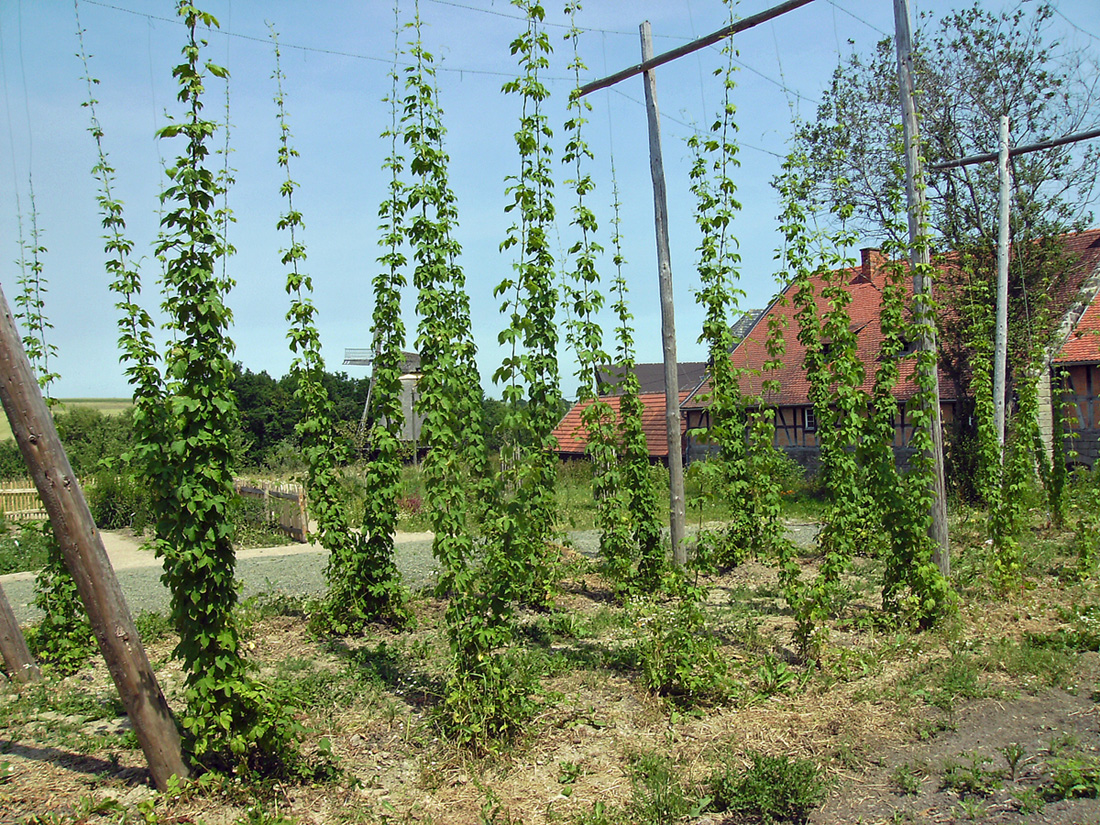
A small hop field completes the various historic agricultural plants in the Open Air Museum. Hop for agricultural use disappeared from fields in Hesse a long time ago. By the mid-19th century at the latest, hop production had consolidated in the Hallertau, a region centrally located between the Bavarian cities of Munich, Ingolstadt, Regensburg and Landshut. Previously, hop gardens had been widespread in Hesse, too, in order to meet the regional demand for brewing. Hops improve the durability of beer and imparts a characteristic aroma. Its use as an additive in brewing remains hop’s most important use. In addition, dried hop flowers protected libraries and private bookshelves from damp and from insects. As a medicinal plant, hop was most often used as a sedative. Where hop was grown on a small scale, as was the case in Hesse well into the 20th century, the shoots were trained up simple wooden poles. After the harvest, these poles were removed and taken to the fields again the following spring. In the Hallertau, on the other hand, larger commercial plantations developed which used wood and wire frames. In our small yard, we show simple hop poles as well as a trestle structure, which was introduced in the early 20th century and developed into today’s frameworks. A hop yard can be used for many years, since the plants are perennials.
You are currently viewing a placeholder content from Google Maps. To access the actual content, click the button below. Please note that doing so will share data with third-party providers.
More InformationYou need to load content from reCAPTCHA to submit the form. Please note that doing so will share data with third-party providers.
More InformationYou need to load content from reCAPTCHA to submit the form. Please note that doing so will share data with third-party providers.
More InformationYou are currently viewing a placeholder content from Turnstile. To access the actual content, click the button below. Please note that doing so will share data with third-party providers.
More InformationYou are currently viewing a placeholder content from Facebook. To access the actual content, click the button below. Please note that doing so will share data with third-party providers.
More InformationYou are currently viewing a placeholder content from Instagram. To access the actual content, click the button below. Please note that doing so will share data with third-party providers.
More InformationYou are currently viewing a placeholder content from Instagram. To access the actual content, click the button below. Please note that doing so will share data with third-party providers.
More InformationYou are currently viewing a placeholder content from X. To access the actual content, click the button below. Please note that doing so will share data with third-party providers.
More Information