



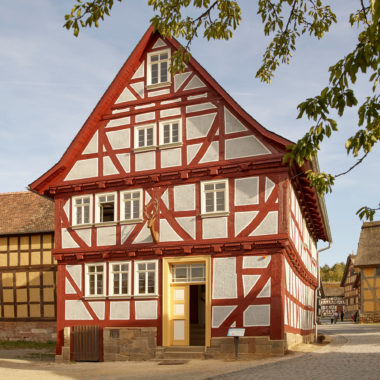
Weaving
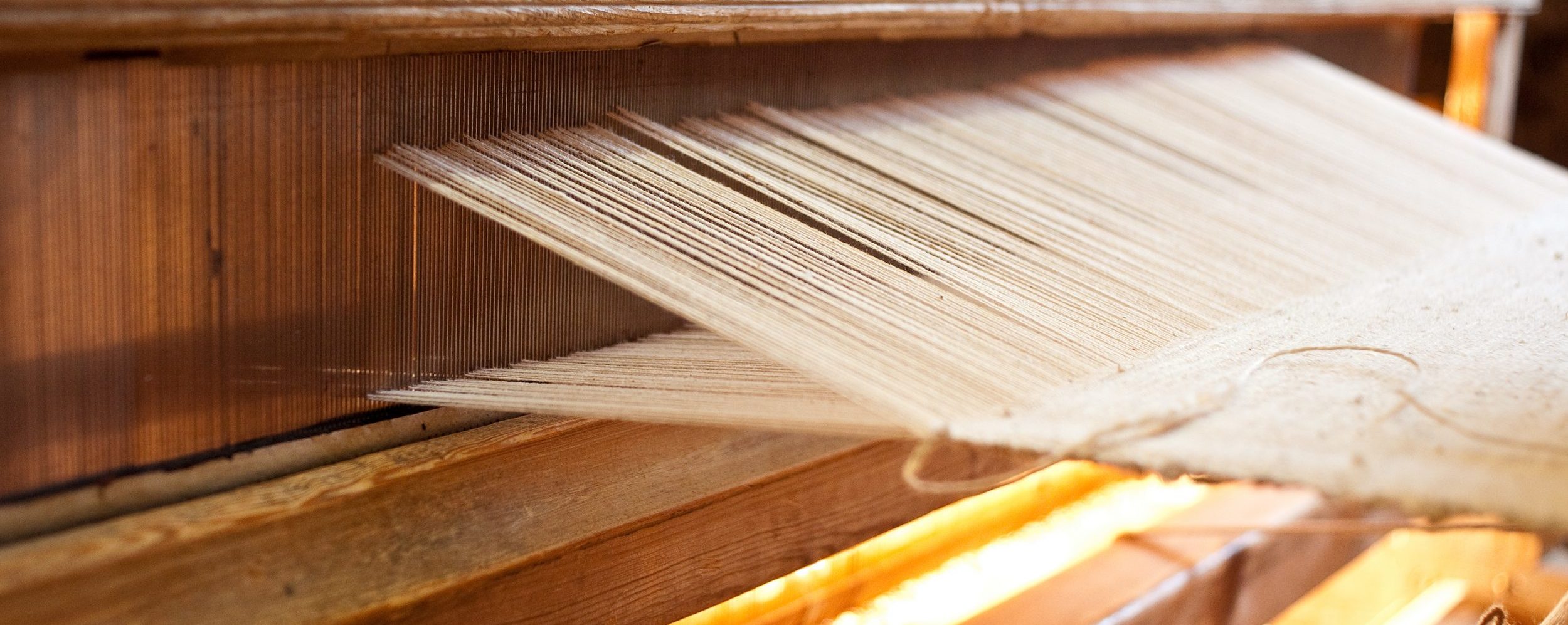
The principle of weaving consists of interlacing a longitudinal warp thread and a weft thread which crosses it at a right angle. Although cloth was made in many country homes for their own use before the industrialization, there were also commercial weavers starting in about 1680. This was a cottage industry which produced canvas which was mostly bought by merchants who would then sell it on at fairs and markets. Since most weavers in Hesse continued to be small-scale part-time farmers, they were not as dependent on the merchants as was the case in Silesia, for example.
The weaver’s pay was simply determined by their product’s success on the market. The flourishing of rural enterprises and the import of East Indian calico, a cotton textile, depressed the price of canvas in the early 19th century. This led to a deterioration of the already less than prosperous condition of rural linen weaving. From about 1850 onwards, the advent of mechanised weaving increased the competitive pressure on weavers. This forced the last master weavers to become wage workers for the wholesale merchants. Thus, weaving as a trade slowly died out in the second half of the 19th century. Although some weavers clung on until the period of high industrialisation, they often confined themselves to weaving patterned cloth which mechanical looms first were not able to do. In the country, weaving was often practiced until about 1940 as a part-time pursuit in the winter months to generate some additional income.
You are currently viewing a placeholder content from Google Maps. To access the actual content, click the button below. Please note that doing so will share data with third-party providers.
More InformationMore links
You need to load content from reCAPTCHA to submit the form. Please note that doing so will share data with third-party providers.
More InformationYou need to load content from reCAPTCHA to submit the form. Please note that doing so will share data with third-party providers.
More InformationYou are currently viewing a placeholder content from Turnstile. To access the actual content, click the button below. Please note that doing so will share data with third-party providers.
More InformationYou are currently viewing a placeholder content from Facebook. To access the actual content, click the button below. Please note that doing so will share data with third-party providers.
More InformationYou are currently viewing a placeholder content from Instagram. To access the actual content, click the button below. Please note that doing so will share data with third-party providers.
More InformationYou are currently viewing a placeholder content from Instagram. To access the actual content, click the button below. Please note that doing so will share data with third-party providers.
More InformationYou are currently viewing a placeholder content from X. To access the actual content, click the button below. Please note that doing so will share data with third-party providers.
More Information